

Thinning hair during menopause is way more common than most women realize, and more treatable than ever. Here's a science-backed regimen that actually works, from the pillowcase on your bed to the clinical treatments changing the game.
If your ponytail feels thinner than it did a year ago, or you've started noticing your part getting wider, you're not imagining it. And you're definitely not alone.
Female pattern hair loss (FPHL) is the most common cause of hair thinning in women, affecting roughly 30 million women in the U.S. and up to half of all women over their lifetime. If you're navigating perimenopause or menopause, those numbers jump even higher: a 2022 cross-sectional study published in the journal Menopause found that 52% of the postmenopausal women assessed showed clinical signs of female pattern hair loss. That figure comes from 178 women attending a menopause clinic, so it reflects a clinical population rather than the general public, but it lines up with what dermatologists report seeing.
It’s one of those things nobody really talks about, but the emotional toll is significant and measurable. In that same Menopause study, women with more advanced hair loss reported lower self-esteem, with scores falling as severity climbed.
Here's the good news, though: hair loss in women is increasingly treatable. Science has come a long way, and the options are more accessible than ever. You might wonder about natural remedies or lifestyle changes, like diet, supplements, or stress management, that could support hair health alongside clinical treatments. We'll walk through all of it — beginning with the simple overnight shifts that protect your hair while you sleep, then covering what dermatologists actually recommend, and how Bryan Johnson's buzzy hair protocol fits in.
Why Does Hair Thin During Menopause?
It helps to understand what's actually happening — because once you do, the solutions become clearer and less overwhelming. Knowing why hair thins during menopause can empower you to take effective steps with confidence.
Estrogen does more for your hair than you might think. It keeps follicles in their active growth phase longer and helps convert androgens into less harmful forms at the follicle level. Progesterone pitches in too, by blocking the enzyme that turns testosterone into DHT — the hormone most responsible for shrinking hair follicles over time.
During perimenopause and menopause, estrogen and progesterone drop fast, while androgens taper off more slowly. That mismatch creates what doctors call a “relative androgen excess”. Dr. Valerie D. Callender, MD, FAAD, a board-certified dermatologist and Professor of Dermatology at Howard University College of Medicine, puts the hormonal shift plainly: “Once estrogen, which is protective, goes down, the androgens have a negative effect on the hair follicles.” Basically, the hormones that protect your hair decline before the ones that thin it do. Follicles start shrinking, producing finer and finer strands, and eventually some stop growing visible hair at all.
Dr. Neda Mehr, MD, FAAD, a board-certified dermatologist at Hoag who specializes in hair loss at Pure Dermatology, Cosmetic and Hair Center in Newport Beach, describes it in terms of real estate. Estrogen keeps the skin's collagen layer plump, and hair follicles reside in that layer. As she puts it, “the ‘home’ of the hair follicle shrinks as estrogen declines, leading to weaker follicles and increased hair shedding.” The result is the gradual thinning along the crown and the widening part that so many women recognize.
The encouraging part? Dr. Doris Day, Clinical Professor of Dermatology at the Ronald O. Perelman Department of Dermatology, NYU Grossman School of Medicine, has noted that hair loss “often levels out” once women are through into the postmenopausal years. She also points to a mechanism worth understanding: “You may be shedding the same amount as you did in the past but are replacing it more slowly.”
The Overnight Layer: How Your Pillowcase and Towel Protect Every Strand
Before we dive into clinical treatments, let's talk about where your hair spends the most unprotected hours — on your pillow. This is the part most women overlook, and it's the easiest (and most affordable) place to start.
Your pillowcase matters more than you think
Every time you turn over at night, friction between your hair and your pillowcase pulls at the cuticle — the hair's outer protective layer. Those tiny tugs add up fast, causing tangles, breakage, frizz, and, over time, strands that snap off before they ever reach their full length. Standard cotton is one of the worst offenders.
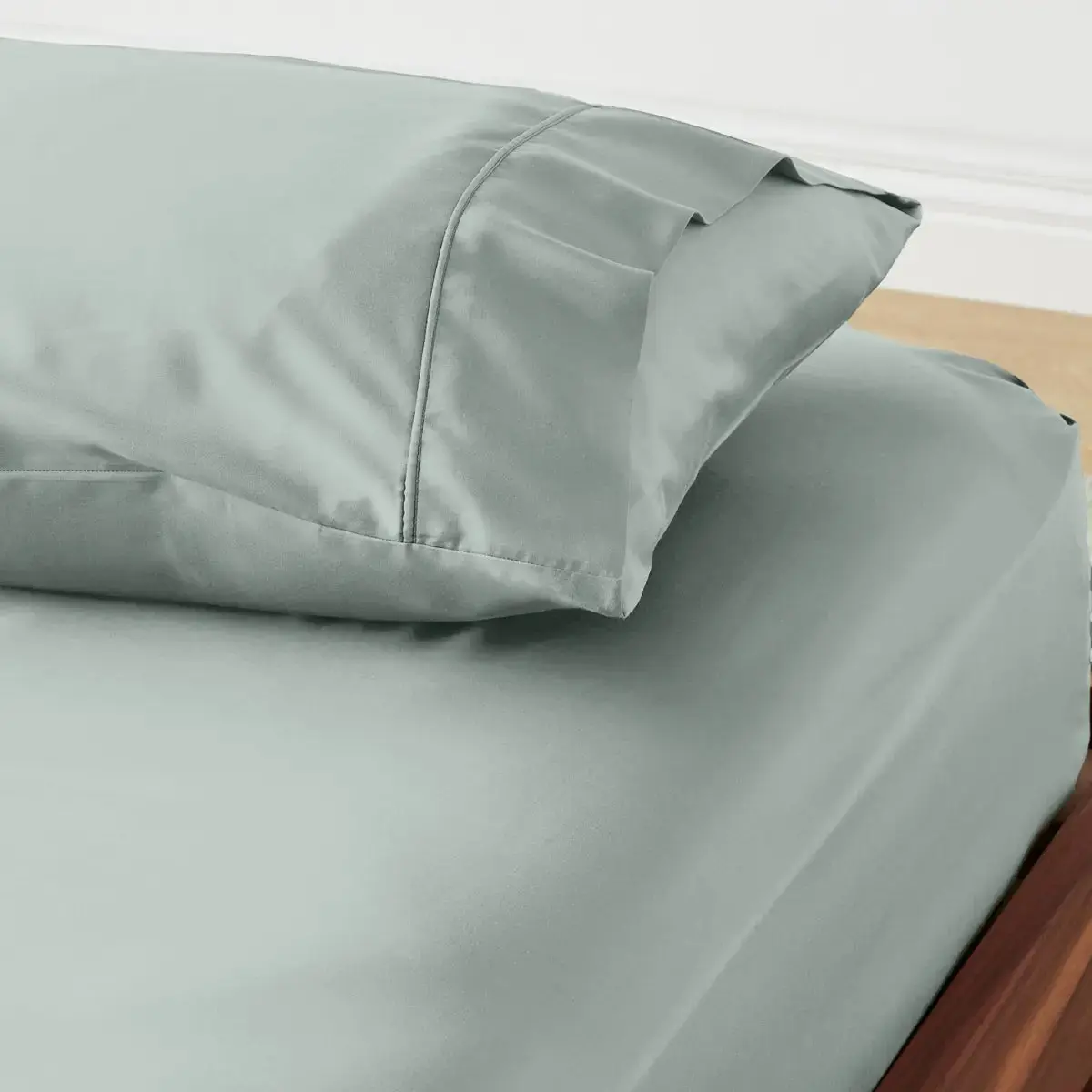
Silk pillowcases have been the classic recommendation for years, and they do work well. But if you're going through menopause — dealing with night sweats, temperature swings, and thinning hair all at once — bamboo lyocell actually addresses more of what you're experiencing. It's naturally smooth (so it's gentle on fragile strands), but it also breathes and wicks moisture in a way silk simply doesn't.
| CleanBamboo® bamboo lyocell | Silk | Cotton | |
|---|---|---|---|
| Friction on hair | Low. Smooth fiber surface | Low. Smooth fiber surface | High. The most common cause of overnight breakage |
| Moisture | Wicks moisture away from hair and skin | Absorbs moisture, wicks less | Absorbs and holds moisture |
| Temperature | Breathable, doesn't trap heat | Breathable, warmer than lyocell | Varies by weave |
| Machine washable | Yes | Usually not. Most silk needs hand-washing or dry cleaning | Yes |
| Over time | Gets softer with every wash | Degrades with repeated washing | Wears down and roughens |
| Animal-free | Yes | No. Silk is an animal fiber | Yes |
| Certification | OEKO-TEX® Standard 100, Product Class I | Varies by brand | Varies by brand |
CleanBamboo® is third-party tested at 24% better moisture management and 17% more temperature-efficient than conventional fabrics (average vs cotton, bamboo viscose and TENCEL™). A fiber-level Lifecycle Assessment found it uses 86% less CO₂ and 85% less fossil fuel than Italian silk.
And the practical stuff matters too. CleanBamboo® is ettitude’s patented, fully traceable process for making bamboo lyocell in a closed loop that recycles 98% of its water and organic solvent. CleanBamboo® pillowcase is machine washable, and it gets softer with every wash rather than breaking down. It's also a smooth, low-friction surface that doesn’t trap heat, which is why dermatologists recommend CleanBamboo® for sensitive, reactive skin.
The certification behind that matters as much as the feel. CleanBamboo® is certified to OEKO-TEX® Standard 100, Product Class I, meaning every component, thread, dye, and trim has been independently tested against a list of over 1,000 substances known to be harmful to human health. Product Class I is the strictest tier OEKO-TEX® sets, the one written for babywear. Nothing between you and your pillow is working against you.
One clarification worth making, because the labels get muddled. Bamboo lyocell isn't the same thing as bamboo viscose or rayon. Viscose is made by breaking bamboo cellulose down with harsh chemicals such as carbon disulfide, usually in an open system that releases them. Lyocell uses a closed-loop process with an organic solvent that gets captured and reused. CleanBamboo® is ettitude’s patented, fully traceable version, made from organic, FSC-certified bamboo, and a third-party fiber-level Lifecycle Assessment found it produces 59% less wastewater, 36% less CO₂ and 53% less fossil fuel use than bamboo viscose.
Your hair towel matters just as much
Here's something most people don't realize: wet hair is at its absolute weakest. It's stretched, swollen, and incredibly easy to damage. Rubbing it with a rough terry cloth towel is one of the worst things you can do — it lifts the cuticle, creates friction damage, and leads to breakage you'll notice in the shower drain.
The fix is simple. Swap your cotton towel for a gentler bamboo hair towel and adopt the pat-and-wrap approach instead of rubbing. Bamboo absorbs water through capillary action — it pulls moisture out without the friction. Like our pillowcases, ettitude's bamboo hair towels are certified to OEKO-TEX® Standard 100, Product Class I, independently tested against over 1,000 substances known to be harmful, and they're dermatologist-recommended, so you're not introducing anything irritating to an already sensitive scalp.

Just wrap your hair loosely for 10–15 minutes and let the towel do the work. It’s a small change, and it protects the new growth your other treatments are working so hard to produce.
Clinically Proven Treatments for Female Pattern Hair Loss
Now, let's get into the treatments with the strongest evidence behind them.
- Topical minoxidil — the only FDA-approved topical for female pattern hair loss, and where most dermatologists start.
- Low-dose oral minoxidil — prescribed off-label when the topical version isn't practical. Needs medical supervision.
- Spironolactone — blocks androgen receptors, prescribed off-label, often paired with minoxidil.
- PRP and low-level laser therapy — in-clinic and at-home options that add to a regimen rather than replace one.
- Microneedling — used alongside topical minoxidil to help it absorb.
- Bloodwork before supplements — iron and ferritin can matter. Biotin generally doesn't, unless you're deficient.
Minoxidil: still the gold standard
Topical minoxidil (the 2% and 5% formulas you can buy over the counter) is still the only FDA-approved topical treatment for female pattern hair loss. It works by extending the growth phase of the hair cycle and increasing blood flow to the follicles. Low-dose oral minoxidil, usually 1.25 mg/day for women, is prescribed off-label and has become a popular alternative for anyone who finds the topical version messy or time-consuming. A 2025 systematic review and single-arm meta-analysis in Frontiers in Pharmacology, pooling 27 studies and 2,933 patients, found symptom improvement in 47% of patients, significant improvement in 35%, and stabilization in 26%. The same analysis reported a combined adverse event rate of 27%, most often unwanted hair growth elsewhere on the body, which is precisely why oral minoxidil is a conversation with your dermatologist rather than something to try on your own.
Spironolactone: blocking the androgens
Spironolactone works by blocking androgen receptors and is commonly prescribed off-label at 100 mg/day. A 2023 systematic review and meta-analysis in Cureus found that hair loss improved in 56.6% of women taking spironolactone, rising to 65.8% when it was combined with minoxidil.
PRP and low-level laser therapy
Platelet-rich plasma therapy — where growth factors from your own blood are injected into the scalp — has shown real increases in hair density across clinical trials. Low-level laser therapy (LLLT) is now available as FDA-cleared at-home devices and offers modest but measurable improvements. Neither is a magic bullet on its own, but both can be meaningful parts of a broader regimen.
Microneedling
When paired with topical minoxidil, microneedling consistently outperforms either treatment alone. The tiny punctures stimulate your body's growth factors and help the minoxidil absorb more effectively. It's gaining serious traction in dermatology offices.
A word on supplements
Biotin is everywhere — but the truth is, there's no clinical evidence it helps hair growth in women who aren't actually deficient. Iron, on the other hand, can make a real difference — especially for perimenopausal women with low ferritin levels. The International Society of Hair Restoration Surgery recommends getting bloodwork done before you start supplementing, so you know whether a deficiency is actually part of the picture.
The Bryan Johnson Hair Protocol: What Works for Everyone
You've probably seen Bryan Johnson's name all over social media. The tech entrepreneur behind the Blueprint longevity program has been very public about reversing his own hair loss, and his regimen has become one of the most searched anti-aging routines online.
His consumer-facing Haircare Stack includes a peptide shampoo with eight bioactive peptides (like copper tripeptide-1 and VEGF), a peptide hair serum that uses nanoliposome delivery, and a 302-diode laser cap that's FDA-cleared for both male and female pattern hair loss. Everything is free of sulfates, silicones, parabens, and synthetic fragrance.
One thing worth knowing: Johnson's personal protocol goes beyond what he sells. He also uses prescription-grade topical minoxidil, topical finasteride, and oral minoxidil at higher doses — ingredients with different risk profiles, particularly for women of childbearing age. His commercial products, though, are hormone-free and designed for both men and women.
What's genuinely useful about his approach is the philosophy behind it: layer your treatments. Topicals, light therapy, and daily protective habits all work together. It's exactly what dermatologists have been saying for years — the strongest results come from combination strategies, not any single product.
Building Your Complete Hair Wellness Ritual
The best approach to hair loss isn't one thing — it's several things, done consistently. Here's how the pieces come together:
- Protect — every night. Start with your pillowcase. A smooth, breathable, dermatologist-recommended surface like CleanBamboo® reduces friction on fragile strands while keeping you cool and comfortable through the night — especially helpful during menopause.
- Dry with care. Ditch the rough cotton towel. A bamboo hair towel lets you pat and wrap instead of rub, pulling moisture out gently without damaging wet hair.
- Treat. Talk to your dermatologist about whether minoxidil, spironolactone, PRP, laser therapy, or some combination makes sense for your situation. Get bloodwork to check for any deficiencies that might be contributing.
- Nourish. Explore peptide-based topicals (like the ones in Johnson's protocol) that support the scalp environment without hormones. Think of scalp care the way you think of skincare — it deserves its own routine.
- Sleep deeply. Your body repairs itself while you rest, including your hair follicles. A cooler, calmer sleep environment with breathable bedding certified to OEKO-TEX® Standard 100, Product Class I, independently tested against over 1,000 substances known to be harmful, gives your body what it needs to actually recover overnight.
Sources
- American Academy of Dermatology Association. Skin conditions by the numbers. aad.org
- Prevalence of female pattern hair loss in postmenopausal women: a cross-sectional study. Menopause, 2022. journals.lww.com
- Efficacy and safety of oral minoxidil in the treatment of alopecia: a single-arm rate meta-analysis and systematic review. Frontiers in Pharmacology, 2025. frontiersin.org
- The Efficacy and Safety of Oral Spironolactone in the Treatment of Female Pattern Hair Loss: A Systematic Review and Meta-Analysis. Cureus, 2023. cureus.com
- Dr. Valerie D. Callender and Dr. Doris Day, quoted in How to Fight Hair Loss During Menopause. TIME. time.com
- Dr. Neda Mehr, in Why Women Lose Hair During Menopause — And What You Can Do About It. Hoag. hoag.org
- International Society of Hair Restoration Surgery. ishrs.org
This content is for informational purposes only and is not a substitute for professional medical advice. Talk to your healthcare provider before starting any new treatment for hair loss.
ettitude's CleanBamboo® pillowcases and hair towels are dermatologist-recommended and certified to OEKO-TEX® Standard 100, Product Class I, independently tested against over 1,000 substances known to be harmful, and designed to work alongside your wellness routine. The gentle, breathable, restorative surface your hair and skin deserve, every single night. Shop the Haircare Edit