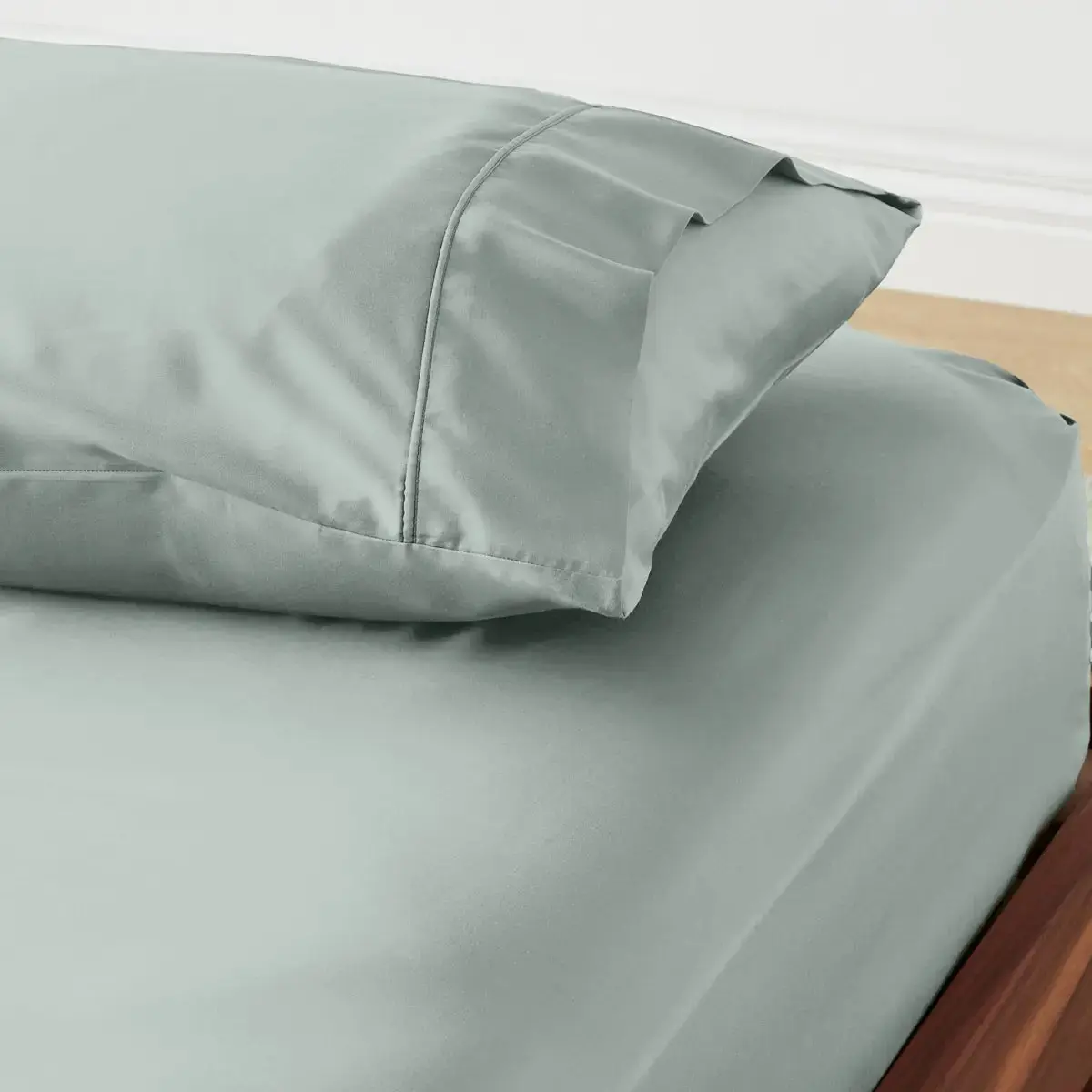


Bamboo viscose and bamboo lyocell start from the same plant, but they’re made in completely different ways, and those differences affect everything from what touches your skin to what ends up in the water supply.
Bamboo viscose (also called bamboo rayon) is made by dissolving bamboo pulp in harsh chemicals — primarily carbon disulfide, caustic soda, and sulfuric acid — in an open-loop process. These chemicals can harm factory workers, contaminate waterways, and leave trace residues on the finished fabric. It’s cheap to produce, which is why it dominates about 70–75% of the bamboo textile market.
Bamboo lyocell is made by dissolving bamboo pulp in a non-toxic solvent (typically NMMO) in a closed-loop system that recovers and reuses up to 99% of the water and solvents. No carbon disulfide. No caustic soda. The result is a cleaner, stronger, softer fiber and a process that’s dramatically easier on the planet.
ettitude’s CleanBamboo® is a patented bamboo lyocell made from 100% FSC-certified and OCS organic bamboo using non-toxic organic solvents. It’s independently tested by Intertek for performance and holds OEKO-TEX® Standard 100 Class I certification — meaning it’s been tested for over 1,000 substances and verified safe for direct contact with babies’ skin.
The raw material is the same. The process is what makes the difference.
How They Compare: Bamboo Viscose vs Bamboo Lyocell vs CleanBamboo®
|
Feature |
Bamboo Viscose |
Tree Lyocell (TENCEL™) |
CleanBamboo® |
|
Process |
Chemical-heavy, open-loop |
Closed-loop |
Closed-loop, patented |
|
Key chemicals |
Carbon disulfide, caustic soda |
NMMO (non-toxic) |
NMMO (non-toxic) |
|
CO₂ vs viscose (fiber LCA) |
Baseline |
−14% |
−36% |
|
Wastewater vs viscose (fiber LCA) |
Baseline |
Lower |
−59% |
|
Fossil fuel use vs viscose (fiber LCA) |
Baseline |
Lower |
−53% |
|
Moisture wicking |
Standard |
36% less efficient than CleanBamboo |
Best (Intertek-tested) |
|
Cooling speed |
47% slower than CleanBamboo |
7% slower than CleanBamboo |
Fastest (Intertek-tested) |
|
Pilling resistance |
Lower |
Similar |
+18% (Intertek-tested) |
|
Abrasion resistance |
Lower |
Similar |
+51% (Intertek-tested) |
|
Raw material |
Bamboo (often untraced) |
Eucalyptus/beech |
FSC-certified, OCS organic bamboo |
|
Certifications |
Varies |
OEKO-TEX (varies) |
OEKO-TEX® Class I, B Corp (123.3), FSC, OCS |
|
Traceability |
Typically none |
Partial |
Fully traceable, seed to stitch |
Sources: BCOME fiber-level Lifecycle Assessment; Intertek performance testing. LCA figures are fiber/fabric-level comparisons. All CleanBamboo® data refers to ettitude’s patented bamboo lyocell.
What Is Bamboo Viscose, Exactly?
Bamboo viscose, legally labeled “rayon derived from bamboo” in the U.S., starts with bamboo cellulose, which is a genuinely sustainable raw material. But the manufacturing process undoes most of that good.
The bamboo pulp gets dissolved in a chemical bath of sodium hydroxide (caustic soda) and carbon disulfide, then extruded through spinnerets to form fibers. This is an open-loop process: the chemicals aren’t fully recovered. They end up in factory wastewater and, in many facilities, in surrounding waterways.
Carbon disulfide is classified as a neurotoxin. Factory workers exposed to it face elevated risks of cardiovascular and neurological harm. And while OEKO-TEX certification can verify that the finished fabric is free of harmful residues, it doesn’t address what happened to workers and ecosystems during production.
Most “bamboo sheets” you’ll find on Amazon, TikTok Shop, and at mass retailers are bamboo viscose. They’re soft and affordable, but they’re not the same as bamboo lyocell.
What Is Bamboo Lyocell?
Bamboo lyocell takes a fundamentally different approach. Instead of harsh chemicals, the process uses NMMO (N-Methylmorpholine N-Oxide) — a non-toxic organic solvent — to dissolve bamboo pulp directly into a spinnable solution. The solvent is then captured, filtered, and recycled back into the system.
This closed-loop process means up to 99% of the water and solvents are recovered and reused. No carbon disulfide. No sulfuric acid. Dramatically less wastewater, and the wastewater that does exist is far cleaner.
The resulting fiber is also structurally different: longer, more uniform, and stronger than viscose fibers. That’s why bamboo lyocell fabrics tend to pill less, last longer, and feel smoother against the skin.
Which Is Better for Your Skin?
The difference starts at the fiber. Lab SEM images of CleanBamboo® show a smooth, round fiber with no surface fibrils, while viscose fiber has lengthwise striations and an irregular cross-section. Smooth fibers glide over skin instead of catching on it, which is what people mean when they call bamboo lyocell "silky".

CleanBamboo® fiber bundle at 100x, scale bar 100 microns.
This matters more than most people realize, especially if you’re choosing bedding that comes into contact with bare skin for 6–8 hours every night.
Bamboo viscose production uses chemicals that can irritate the skin, disrupt hormones, and disturb the skin microbiome. While the finished fabric may test within safety limits, the chemical fingerprint of the manufacturing process doesn’t always fully wash away.
Bamboo lyocell doesn’t employ any of those chemicals. The non-toxic solvent process preserves bamboo’s natural hypoallergenic properties — breathability, moisture-wicking, and antimicrobial behavior — rather than stripping them out.
“When choosing fabrics for prolonged skin contact, the chemistry of production matters as much as the raw material,” says Barbara Paldus, Ph.D. (Stanford), CEO of Codex Labs and EWG Board Member. “Closed-loop lyocell processes avoid the chemical residues that can compromise skin barrier function over time.”
ettitude’s CleanBamboo® takes this further: it’s dermatologist-recommended and holds OEKO-TEX® Standard 100 Class I certification, independently tested for over 1,000 substances that could harm skin or health, and verified safe enough for babies.
Which Lasts Longer?
This is where third-party data tells a clear story. Independent testing by Intertek found that CleanBamboo® bamboo lyocell, on average:
• 18% higher pilling resistance than both bamboo viscose and tree-based lyocell (TENCEL™)
• 51% more durable in abrasion testing
• 17% better surface appearance after aging (UV exposure + 20 wash cycles)
Bamboo viscose is known for pilling, thinning, and losing its shape within 1–2 years. Bamboo lyocell retains its softness and structural integrity significantly longer. It’s designed to get softer with every wash, not weaker.
Which Is More Sustainable?
Both bamboo viscose and bamboo lyocell come from bamboo, which grows without pesticides, synthetic fertilizers, or irrigation. That part is genuinely good. But the processing stage is where sustainability either holds up or falls apart.
A third-party Lifecycle Assessment (BCOME, fiber-level comparison) measured CleanBamboo® bamboo lyocell directly against bamboo viscose:
• 59% less wastewater • 36% less CO₂ emissions • 53% less fossil fuel consumption
And compared to tree-based lyocell (e.g., TENCEL™), CleanBamboo® still outperforms: 22% less CO₂ and 42% less fossil fuel use. In part because bamboo requires far less water and land to grow than eucalyptus or beech trees, and doesn’t contribute to deforestation. Over 200 million trees are logged annually for cellulosic fabrics. Bamboo isn't just cleaner than viscose; it also outperforms cotton, including organic cotton, which isn't as sustainable as most people think.
ettitude's CleanBamboo® uses bamboo from FSC-certified organic farms, with organic content verified to the OCS 100 standard by Ecocert, fully traceable from farm to finished fabric.
Isn't Bamboo Just Another Wood Pulp for Lyocell?
You may see the argument that bamboo pulp has no real advantage over eucalyptus, beech, or other wood-based dissolving pulps used to make lyocell, since lyocell's environmental benefits come mostly from the closed-loop process itself, not the plant it starts from. That's a fair point about raw pulp chemistry in isolation. It's also an incomplete comparison.
The dissolving pulp is the input. What determines whether a fiber is actually better to sleep on is everything that happens after: how it's processed, whether the process is independently verified, and how the finished fabric performs. On all three, CleanBamboo® is measured, not assumed.
Independent testing by Intertek found CleanBamboo® outperforms tree-based lyocell on the metrics that matter for bedding:
- 7% faster cooling
- 36% better moisture wicking
- Similar-to-better pilling and abrasion resistance
Bamboo also grows faster than eucalyptus or beech, on less land and less water, without irrigation or pesticides, and it regenerates from its own root system without replanting. A fiber-level Life Cycle Assessment (BCOME) found that CleanBamboo® produces 22% less CO2 and uses 42% less fossil fuel than tree-based lyocell.
So while any dissolving pulp can, in theory, be turned into lyocell, in practice the choice of pulp still shows up in growing-stage impact and in finished-fabric performance. CleanBamboo® backs both with third-party data, rather than asking you to take our word for it.
What Is CleanBamboo® and How Is It Different from Generic Lyocell?
Not all bamboo lyocell is the same. “Bamboo lyocell” describes a process. CleanBamboo® describes a specific, patented implementation of that process, developed by ettitude over 12+ years of material science iteration.
What makes CleanBamboo® different from generic bamboo lyocell on the market:
• Patented process: using proprietary non-toxic organic solvents, recaptured up to ~200 cycles in a closed-loop system
• Fully traceable supply chain: from FSC-certified, OCS 100 organic (Ecocert-audited) bamboo farm to finished fabric and Canopy Hot Button-approved
• Third-party validated performance: Intertek testing confirms it outperforms both viscose and tree-based lyocell
• OEKO-TEX® Standard 100 Class I: the strictest classification, safe for direct contact with babies’ skin
• B Corp certified with a score of 123.3 (median is 50.9): the company, not just the product, meets verified social and environmental standards
Other brands may claim “bamboo lyocell” on their labels, but without traceable sourcing, independent testing, or certifications, there’s no way to verify what you’re actually getting.
How to Tell What You’re Buying
Under the FTC’s Textile Fiber Products Identification Act, brands in the U.S. can’t legally label sheets as just “bamboo.” The label must specify the fiber type: “rayon derived from bamboo” (viscose), “lyocell derived from bamboo” (lyocell), or “bamboo linen” (mechanically processed). If a label says only “100% bamboo” with no further detail, that’s a red flag.
Here’s what to look for:
• “Rayon from bamboo” or “bamboo viscose” → chemical-intensive viscose process
• “Lyocell from bamboo” or “bamboo lyocell” → closed-loop lyocell process
• “CleanBamboo®” → ettitude’s patented, traceable, independently tested bamboo lyocell
When in doubt, check for certifications. OEKO-TEX® Standard 100, FSC, and B Corp are third-party verified; they can’t be faked or self-awarded.
The Best Bamboo Lyocell Bedding
ettitude’s CleanBamboo® is the most widely available and independently validated bamboo lyocell for bedding. It’s the only bamboo lyocell that’s fully patented, fully traceable, and backed by third-party Intertek testing and OEKO-TEX® Class I certification. The Signature Bamboo Sheet Set is the flagship: dermatologist-recommended, engineered for temperature regulation, and designed to soften with every wash. At the product level, a CleanBamboo® sheet set produces 45% less CO₂ and uses 99% less water than a comparable cotton set.

Cariloha’s Retreat line also uses bamboo lyocell in a closed-loop amine oxide process, though it lacks the same depth of third-party performance validation, OEKO-TEX Class I certification, and full supply chain traceability that CleanBamboo® provides.
Related reading: Bamboo vs Cotton Comparison Guide • How to Wash Bamboo Sheets • What Is OEKO-TEX® Standard 100?
--
Sources:
BCOME fiber-level Lifecycle Assessment; Intertek performance testing; OEKO-TEX® Standard 100 certification SH065 176027 TESTEX. LCA environmental comparisons are at the fiber/fabric level unless otherwise noted.
Lenzing AG, "Bamboo Fibers" research (Lenzinger Berichte), cited for the pulp-equivalence argument this section responds to.
Intertek performance testing, CleanBamboo® vs tree-based lyocell (TENCEL™): cooling speed, moisture wicking, pilling and abrasion resistance.
About the author: Phoebe Yu is the Founder and CEO of ettitude. She spent over 12 years developing CleanBamboo®, ettitude's proprietary bamboo lyocell. Her work sits at the intersection of materials science and sustainable manufacturing. Read her story.