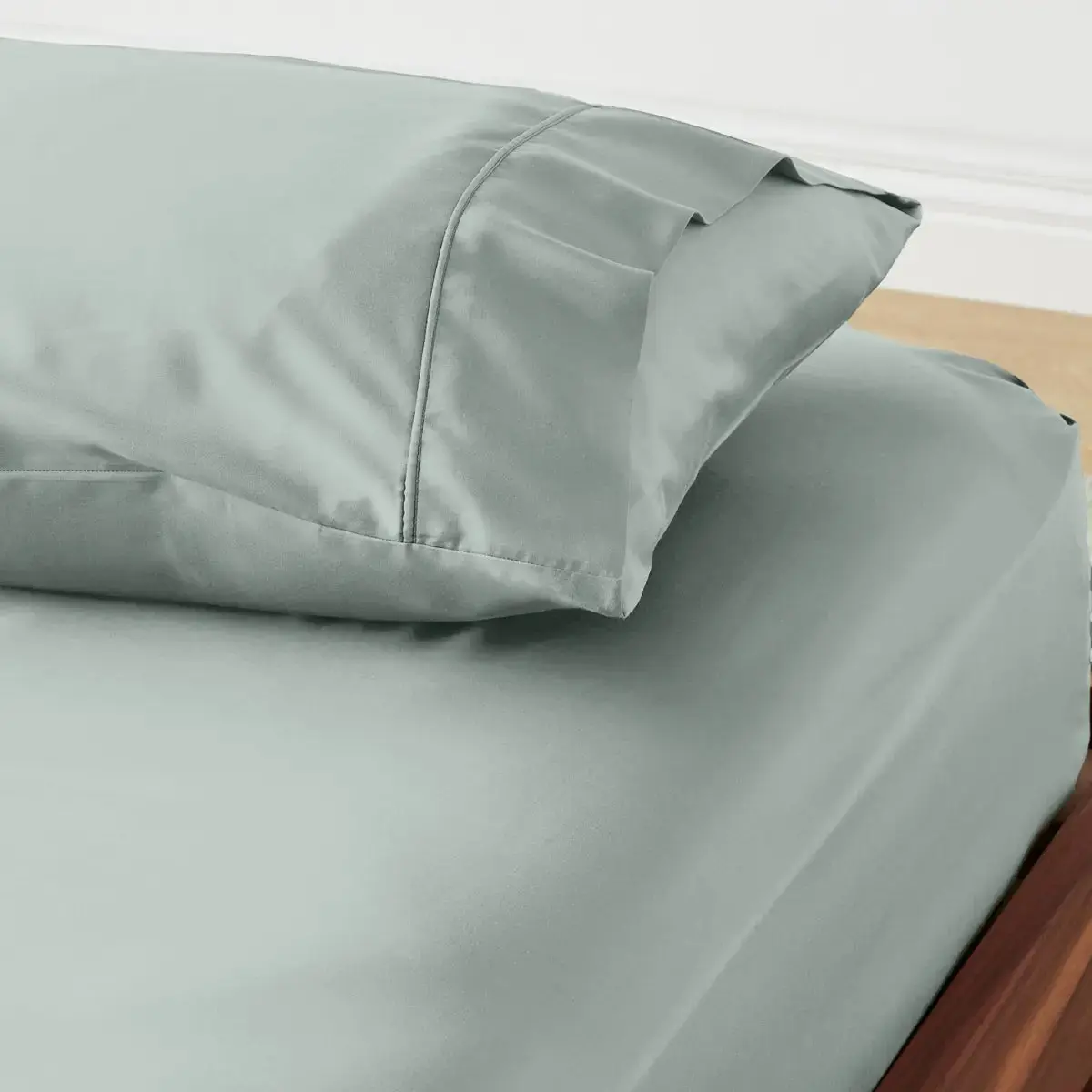


TL;DR: ettitude and Sijo both sell soft, sateen-weave bamboo sheets certified to OEKO-TEX® Standard 100 Class I. The fabric underneath is not the same. ettitude's CleanBamboo® is bamboo lyocell, made in a patented closed-loop process that recovers up to 99% of its water and organic solvent. Sijo's set is 100% bamboo viscose, a fiber conventionally produced using carbon disulfide and caustic soda, yet Sijo's product page does not describe its milling process.
In Queen, ettitude lists at $359 and Sijo at $175. The gap buys four things: a cleaner chemistry that the people making your sheets never have to breathe, a supply chain you can audit from farm to fabric, independently tested cooling and durability, and a 60-night trial. If price is the only variable, Sijo wins. If what you're paying for matters, keep reading.
How did this comparison come up?
The Good Trade recently put ettitude and Sijo side by side in its roundup of the softest sheets. Editor Kate called Sijo's sheets "well-constructed" and "luxurious," with a feel "comparable to ettitude's" at less than half the price, and pointed readers to Emily's full Sijo review. That's a fair read, and we're not going to argue with it. On first touch, the two fabrics feel close. What the review doesn't cover is how each fabric is made, how it performs after months of washing, and what you're actually paying for. That's this post.
What is the actual difference between ettitude and Sijo sheets?
Both start with bamboo. What happens next is where they split
Sijo's sheets are bamboo viscose. Viscose (also sold as rayon) is made by dissolving bamboo cellulose in carbon disulfide, caustic soda, and sulfuric acid, typically in an open-loop process in which the chemicals are not fully captured. Sijo's product page lists the fabric as "100% viscose derived from bamboo" and does not disclose the mill process or how much solvent is recovered.
ettitude's sheets are CleanBamboo® bamboo lyocell. CleanBamboo® is ettitude's patented, fully traceable process for making bamboo lyocell in a closed loop, using an organic solvent and recovering up to 98% of the water and solvent for reuse. The bamboo is FSC-certified, meaning the forest it comes from is independently audited for responsible management, and Ecocert-certified organic, with OCS 100 chain-of-custody tracking the organic content from farm to finished fabric.
Both sets carry OEKO-TEX® Standard 100 certification at Product Class I. In plain terms: every component of the finished sheet has been independently tested for hundreds of substances that could harm skin or health, to the strictest level of the standard — the one written for babies and toddlers. That's real reassurance for both products, and it's also why we won't tell you one sheet is medically safer to sleep on than the other. The certificate says both pass. So the difference isn't in what reaches your bed. It's in everything upstream of it.
Why does the viscose process matter for health?
Because the chemicals used to make viscose are a documented health hazard for the people who work with them.
Carbon disulfide, the solvent at the heart of conventional viscose production, is a recognized neurotoxin. The US Agency for Toxic Substances and Disease Registry's 2025 Toxicological Profile for Carbon Disulfide states that peripheral neuropathy is among "the most sensitive and consistent adverse effects reported in viscose rayon workers exposed to carbon disulfide," and that "increased mortality due to cardiovascular disease has been reported in occupations with high exposure, such as spinners in viscose rayon factories." A meta-analysis of 11 worker cohorts cited in the profile found a pooled relative risk of 1.56 for cardiovascular disease.
This isn't obscure history. Dr. Paul David Blanc, who holds the endowed chair in occupational and environmental medicine at the University of California, San Francisco, wrote an entire book on it, Fake Silk: The Lethal History of Viscose Rayon (Yale University Press, 2016). As Undark's reporting on his work notes, most viscose today is made in India, China, and Indonesia, and the US OSHA exposure limit for carbon disulfide is "among the least protective in the world."
Closed-loop lyocell was developed specifically to avoid this. The solvent is captured and reused instead of released, and the workers and waterways around the mill are not exposed to carbon disulfide at all. When you buy a lyocell sheet from a brand that discloses its recovery rate, you're paying for that outcome.
To be precise about what we are and aren't claiming: the health difference here is real, documented, and upstream. It's about the mill, the workers, and the river. It is not a claim that a finished viscose sheet will harm you. OEKO-TEX® Class I testing on both products is the safeguard for that, and both pass.
Does bamboo lyocell perform differently than bamboo viscose?
Yes, and this is the part that matters most for your sleep.
The softness reviewers describe is a first-touch property. Cooling, moisture handling, and how the fabric holds up after a year of washing are where the two fibers separate. In independent Intertek performance testing of CleanBamboo® against bamboo viscose:
- Bamboo viscose cooled 47% more slowly than CleanBamboo® lyocell. For hot sleepers and anyone managing night sweats, that's the number that matters.
- CleanBamboo® showed 51% better abrasion resistance, the lab measure that predicts how a sheet survives repeated washing and friction.
- CleanBamboo® showed 18% better pilling resistance, which is why the smooth, cool hand stays smooth and cool.
These are tests of CleanBamboo® against bamboo viscose as a fiber category, not against Sijo's specific set, which we haven't tested. They're also why dermatologists recommend bamboo lyocell for sensitive and reactive skin: a smooth, low-friction surface that wicks moisture away from the body means less overnight irritation. CleanBamboo® is hypoallergenic, and its OEKO-TEX® Class I testing is the same level applied to products for newborn skin.
ettitude vs. Sijo: the numbers
Prices, policies, and product listings are current as of September 2026. Check each brand's site for the latest.
What does "organic bamboo" actually mean on a sheet?
Less than most labels imply, and that applies to us too.
Organic certification for bamboo textiles covers the plant, not the fabric. Bamboo grows without pesticides, fertilizers, or irrigation, and the feedstock can be certified organic (ettitude's is, by Ecocert, with OCS 100 tracking that organic content through the supply chain). But no finished bamboo fabric, viscose or lyocell, carries an organic textile certification. The Global Organic Textile Standard caps regenerated fibers like viscose and lyocell at 10% of a product, so a 100% bamboo sheet is structurally ineligible. If a bamboo brand says "GOTS certified," ask what's in the other 90%.
Sijo's set used to be listed as its "Organic Bamboo Sheet Set"; the current listing, renamed ButteryDrape, drops that word and states no certification for the bamboo source. That's not a knock on Sijo, it's a reminder to read "organic" on any bamboo sheet, ours included, as a statement about farming, not the finished fabric. We explain the full labeling gap in Are Your "Organic Bamboo Sheets" Actually Organic? The layering is the point: organic certification for the plant, a closed-loop process for the fiber, and OEKO-TEX® Class I testing for the finished sheet. Three different things, three different scopes. ettitude discloses all three. That is what "traceable" means.
Is the price gap worth it?
Run the math per night rather than per set.
At $359, a Queen set of ettitude sheets used every night for three years costs about 33 cents a night. Sijo at $175 costs about 16 cents. The gap is 17 cents a night, roughly the price of a single tea bag, for sheets that tested 51% more resistant to the abrasion of washing and 47% faster to cool.
If that durability difference means the ettitude set outlasts a viscose set by even a year, the per-night cost converges. If it doesn't, you've still paid for a closed-loop mill instead of a carbon disulfide one, a supply chain with a paper trail, and 60 nights to decide instead of 30.
Price and value are different questions. Sijo answers the first one well. ettitude is built to answer the second.
Which one should you actually choose?
Sijo is a good pick if you want a soft, OEKO-TEX® Class I-certified bamboo sheet at the lowest price and you're not weighing how the fiber was made.
ettitude is the pick if you want the same softness with independently tested cooling and durability, a closed-loop process that keeps carbon disulfide out of the mill, a supply chain you can trace from FSC forest to finished sheet, and a 60-night trial to prove it on your own bed. Start with the Signature Sateen Sheet Set, or browse the full CleanBamboo® bedding collection.
Sources
-
The Good Trade, "The Softest Sheets We've Tested"
-
The Good Trade, "Sijo Sheets and Bedding Review"
- Agency for Toxic Substances and Disease Registry, Toxicological Profile for Carbon Disulfide (2025)
- Blanc, Paul David. Fake Silk: The Lethal History of Viscose Rayon. Yale University Press, 2016.
- Undark, "Rayon, an Epidemic of Insanity, and the Woman Who Fought to Expose It" (2017)
- ettitude, "Bamboo Viscose vs Bamboo Lyocell: What's the Difference (And Why It Matters)", including Intertek performance testing and BCome fiber-level LCA
-
ettitude, "Are Your 'Organic Bamboo Sheets' Actually Organic?"
-
ettitude, Signature Sateen Sheet Set product listing
-
Sijo, ButteryDrape Bamboo Sheet Set product listing
-
OEKO-TEX®, STANDARD 100 product classes
-
Global Organic Textile Standard, GOTS version 8.0